Transmission container (T-CONT)
T-CONT is short for Transmission Container. Entity used for upstream BW allocation.
In the upstream direction, data is contained in GEM frames (b/w ONT–OLT) . Why does the T-CONT need to be introduced?
It can be regarded as QoS control. In GPON, the T-CONT implements dynamic bandwidth assignment (DBA). An ONU applies for bandwidth using T-CONTs, and the OLT allocates bandwidth to T-CONT. In this way, the bandwidth is dynamically allocated in the upstream direction in the GPON system.
Bandwidth authority is correlated with only one T-CONT.
The bandwidth information is sent to the ONU through the BWmap field of the downstream frame. After receiving the bandwidth information, the ONU allocates the bandwidth to the queues on the T-CONT.
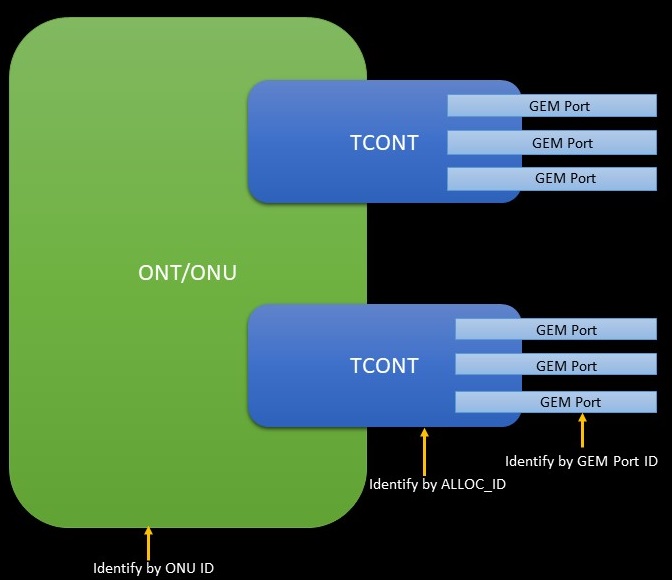
T-CONT is the minimum scheduling unit for upstream bandwidth allocation. Each T-CONT is uniquely identified with an Alloc-ID that is globally allocated by the OLT , namely, each ONU of the OLT can only use a T-CONT with the unique Alloc-ID.
GPON Traffic Flow in Network
IP Network (Ethernet Frame)==OLT (GEM Frame)==ONT(Ethernet Frame)
OLT Broadcast All Data (GEM1,GEM2…) to ONTs,but in ONT it will filter using Port ID in GEM Frame , Once ONT Receive GEM Frame will process only data which belongs to it. OLT Assigning different time slot to each ONT.and ONT can only send back data on that specific time slot assigned by OLT.
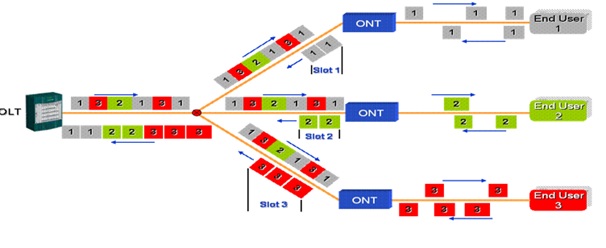
Data Transmission ;Downstream:
Downstream :From OLT to ONT (User)
Max 2.5 Gbit/s Wave length Downstream: 1480 nm-1450 nm , 1490 ;data packet transmitted in an broadcast manner (AES encryption used to prevent eavesdropping)
Data Transmission ;Upstream:
Upstream :From ONT (User) to OLT
Max 1.25 Gbit/s ,Wave length Upstream: 1290 nm – 1330 nm (narrowed) , 1310 nm;
ONTs are located at different distance ,(same wavelength + Same fiber ) so data packet transmitted in a TDMA manner .
1.Distance OLT-ONT measured.
2.Timeslot allocated according to distance.
3.ONT send upstream according to granted timeslot.
GPON Integration Scenarios
FTTx Internet Service Scenario
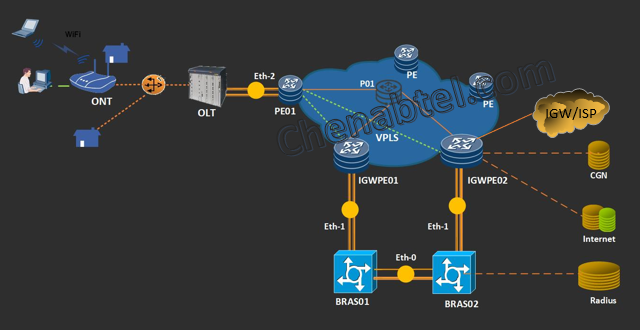
To achieve internet services at user home/office/building via FTTx ,multiple integrations implemented in Operator network from GPON toward MPLS Network & IGW and to improve resource also other elements CGN,DPI ,RADIUS .Briefly explained below :-
OLT-ONT/ONU Service
As OLT Broadcast All Data (GEM1,GEM2…) to ONTs, but in ONT it will filter using Port ID in GEM Frame. In Order to work GEM Protocol between OLT-ONT multiple elements need to configure in OLT/ONT. Brief Steps below
- Bind ONT/ONU using LOID or SN.
- Configure Traffic Profiles for Bandwidth Restrictions.
- Bind TCONT(Upload BW) with GEM Ports (Virtual Ports between OLT-ONT).
- Configure Service port for translating SVLAN & CVLAN.
- Create Line/Remote(ZTE) or Line/Serv Profiles(Huawei) In case of large numbers of customers.
OLT–PEs–IGW PEs
From OLT-PE Uplink Eth-Trunk interface configured in order to Allow multiple service vlans (Internet:1588,Voice:1500 etc) and from PE vpls is configured peering with IGW PE ;binding int/Sub interface (For example interface Vlanif1588)
IGW-PEs–BRAS
Uplink Eth-Trunk interface configured in order to Allow multiple service vlans (Internet:1588,Voice:1500 etc).
ONT—BRAS/BNG:
How ONU/ONT modem at home receive WAN IP ?
PPOE or DHCP is configured in BRAS devices and clients are multiple ONT/ONUs Modems WAN port. Below is screenshot from ONT web GUI.IP address 100.74.75.19 is assigned by Gateway IP 100.74.75.254 BRAS/BNG Device.
- BRAS/BNG : Enable PPOE Server on interface toward IGW-PE “Eth-Trunk1.1” (Bind multiple Vlans e.g internet1588) and creating local IP address Pool with gateway for assignment.
- ONT: Configure PPOE Client configuration User/Password etc.
By using this method multiple IPs are assigned to multiple WANs in ONT for each service (Internet , Voice ,ACS etc).
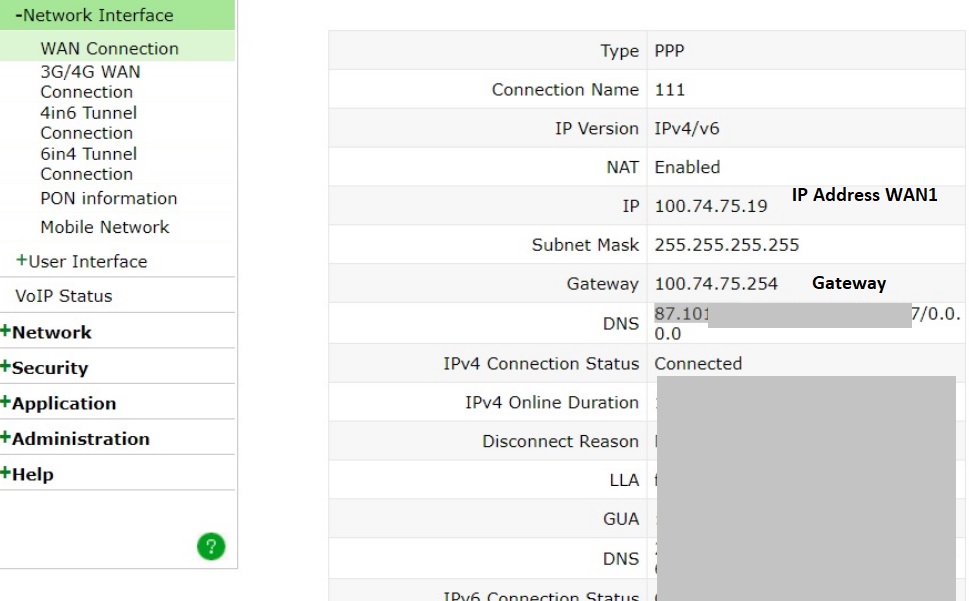
Note: Above Assigned IP is Actually from Standard CGNAT IPs Range 100.64.0.0 and 100.127.255.255 . later it will translate to Public IPs using CGN (Basically its large scale NATing Setup) Commonly Large scale operators are using it to save Public IPs.
Comment :RADIUS authentication and RADIUS accounting are configured on the BRAS. The ONU/ONT obtains an IP address from the BRAS after passing the authentication.