All posts by pk-admin

Splitter

 Fiber optic splitter, also referred to as optical splitter, or beam splitter, Its Waveguide optical power distribution device.

Passive device used for light beam to be divided two or more light beams.(one port divide to two or more ports).

How Does  Splitter Work?

When the light signal transmits in a single-mode fiber, the light energy cannot entirely concentrate in the fiber core. A small amount of energy will be spread through the cladding of fiber. That is to say, if two fibers are close enough to each other, the transmitting light in an optical fiber can enter into another optical fiber. Therefore, the reallocation technique of optical signal can be achieved in multiple fibers. And this is how fiber optic splitter comes into being.

Splitter Loss1:n  ==>10log(n)
1:2-3dbm
1:4-6dbm
1:8-9dbm
1:16-12dbm
1:32-15dbm
1:64-18dbm
1:128-21dbm
Splitter types
  • FBT : Fused Biconic Taper Is used especially for instances where the split configuration is smaller (1:2, 1:4, 2:2, etc.).
  • PLC : Planar Lightwave Circuit ,Waveguides are fabricated using lithography onto a silica glass substrate,offer accurate and even splits with minimal loss.It is more compact and is lower cost with greater degrees of splitting.
Transmission container (T-CONT)

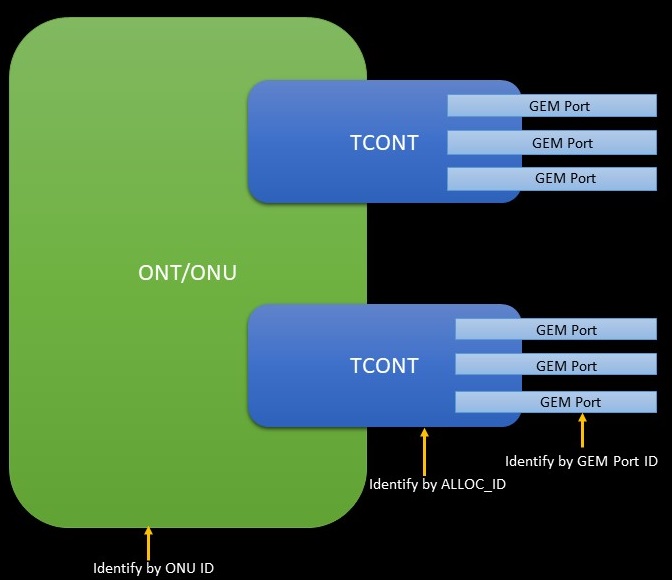
T-CONT is short for Transmission Container. Entity used for upstream BW allocation.

In the upstream direction, data is contained in GEM frames (b/w ONT–OLT) . Why does the T-CONT need to be introduced?

It can be regarded as QoS control. In GPON, the T-CONT implements dynamic bandwidth assignment (DBA). An ONU applies for bandwidth using T-CONTs, and the OLT allocates bandwidth to T-CONT. In this way, the bandwidth is dynamically allocated in the upstream direction in the GPON system. 

Bandwidth authority is correlated with only one T-CONT.

The bandwidth information is sent to the ONU through the BWmap field of the downstream frame. After receiving the bandwidth information, the ONU allocates the bandwidth to the queues on the T-CONT.

T-CONT is the minimum scheduling unit for upstream bandwidth allocation. Each T-CONT is uniquely identified with an Alloc-ID that is globally allocated by the OLT , namely, each ONU of the OLT can only use a T-CONT with the unique Alloc-ID.

GPON Traffic Flow in Network

IP Network (Ethernet Frame)==OLT (GEM Frame)==ONT(Ethernet Frame)

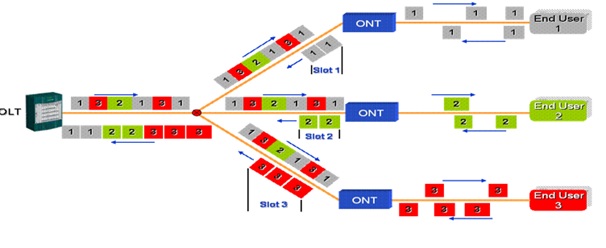
OLT Broadcast All Data (GEM1,GEM2…) to ONTs,but in ONT it will filter using Port ID in GEM Frame , Once ONT Receive GEM Frame will process only data which belongs to it. OLT Assigning different time slot to each ONT.and ONT can only send back data on that specific time slot assigned by OLT.

Data Transmission ;Downstream:

Downstream :From OLT to ONT (User)

Max 2.5 Gbit/s Wave length Downstream: 1480 nm-1450 nm , 1490 ;data packet transmitted in an broadcast manner (AES encryption used to prevent eavesdropping)

Data Transmission ;Upstream:

Upstream :From ONT (User)  to OLT

Max 1.25 Gbit/s  ,Wave length Upstream: 1290 nm – 1330 nm (narrowed) , 1310 nm;

ONTs are located at different distance ,(same wavelength + Same fiber ) so data packet transmitted in a TDMA manner .

1.Distance OLT-ONT measured.

2.Timeslot allocated according to distance.

3.ONT send upstream according to granted timeslot.